Parent guide · Facts checked October 2026
Lincoln AI Learning Coach vs ChatGPT, Khanmigo and Brainly, compared for parents
Price, what each one is built on, whether it gives answers, what you can see afterward, and safety, side by side.

By Nicole Costlow, Lincoln Learning Solutions. Published October 2026. Facts checked October 2026.
If you want an AI that helps your child with homework without doing the work for them, the four tools parents ask us about most are ChatGPT (including the new ChatGPT for Teens), Khanmigo, Brainly and our own Lincoln AI Learning Coach. They differ on price, on what they are built from, on whether they give the answer, and on what information you can see afterward. Here is how they compare, with the numbers as they stood in October 2026.
The short version
| Lincoln AI Learning Coach | Khanmigo | ChatGPT and ChatGPT for Teens | Brainly | |
|---|---|---|---|---|
| Price | $14.99 a month per child, or $149.99 a year ($12.50 a month) | $4 a month or $44 a year, for up to 10 children on one parent account | Free tier. Paid plans from $8 a month. ChatGPT for Teens is the under-18 version of the same product, not a separate price | Free to ask and answer. Brainly Plus $9.99 a month or $39.99 a year. Brainly Tutor $33 a month or $96 a year |
| Free trial | 7 days, cancel anytime | None listed. The Khan Academy library itself is free | The free tier is the trial | The free tier is the trial |
| Ages and grades | K-12 | Elementary school through college. Children must be under 18 on a parent account | 13 and up. Users 13 to 17 are placed in ChatGPT for Teens automatically | Grades 7-12, ages 13 and up |
| What it is built on | Lincoln's own K-12 curriculum, the one schools and districts license, with proprietary AI and leading third-party AI models | Khan Academy's library plus a general AI model | A general AI model trained on the open internet | An expert community of answers plus an AI layer |
| Answers or coaching | Coaches. It asks questions and works the problem step by step instead of giving the answer, including on worksheets your child uploads | Coaches. In Khan’s words, it “doesn’t just tell your kids the answers” | Answers by default. Study Mode asks guiding questions instead, and for teens a homework reminder nudges them toward it. A teen can turn Study Mode off | Answers, with an explanation attached. Asks follow-up questions for further learning. |
| What a parent sees | A parent dashboard with the topics your child worked on, strengths, areas to improve and suggested next steps, plus a dashboard alert when a conversation is concerning and an email for serious ones | The full chat history and moderation alerts, in a parent dashboard | Parents with a linked account can set quiet hours, study hours and content filters and get safety notifications, which OpenAI says start about three hours after the accounts are linked. They do not see the conversations | Parents with a linked account can track learning progress, see their child’s strengths and weaknesses, and help them with homework. Must have a week’s progress to show information. |
| Safety | Keeps conversations on learning and age-appropriate, and redirects off-topic requests. Parents get an email and a dashboard alert if a conversation raises self-harm or threats of violence. Member of the EdSAFE AI Industry Council. | Moderation flags concerning chats. Parents get an email when a chat is flagged, and chat logs are kept for review. | Under-18 protections on by default, with age estimated or self-reported. Linked parents get safety notifications after review by OpenAI staff. Common Sense Media rated ChatGPT for Teens an unacceptable risk for users under 18 in October 2026. OpenAI disputes the findings | An honor code with moderators, and users who break it can be banned. Parents get progress updates but no safety alerts. |
| Subjects | Math, English language arts, science, social studies and electives, K-12. Your child can ask any school question | Math, science, coding, history and humanities | Anything | 21 subject areas |
| Who makes it | Lincoln Learning Solutions, a Pennsylvania nonprofit founded in 2005 | Khan Academy, a nonprofit | OpenAI | Brainly, a for-profit company |
Prices and features as listed on each company’s site in September and October 2026. Sources, with the date each was checked, are at the end of the page.
Which one helps a child learn instead of doing the work for them?
Lincoln AI Learning Coach and Khanmigo are built to guide a child rather than hand over the answer. Learning Coach asks what your child has tried and works the problem one step at a time, and when a child uploads a worksheet to Homework Helper, it coaches through that the same way. ChatGPT gives the answer by default unless Study Mode is on. For homework, that difference matters more than any other row in the table.
A 2024 study from the University of Pennsylvania followed nearly a thousand high school students through a math unit. Students who used a standard version of ChatGPT solved 48% more practice problems and then scored 17% worse on the exam than students with no AI at all. A version of ChatGPT set up to give hints instead of answers erased the exam penalty. The tool that gave answers made practice look better and learning worse. The one that coached did no harm. That is the whole argument for a coach in one study, and it is why we built Learning Coach the way we did.
To be fair to ChatGPT, Study Mode now does something close to coaching, and ChatGPT for Teens nudges a 13 to 17 year old toward it when the homework pattern shows up. The difference is that a teen can turn it off, and a child under 13 cannot use ChatGPT at all under its rules. When Common Sense Media tested ChatGPT for Teens in October 2026, a “Show me the answer” option appeared in 43% of responses for a 13-year-old with parent-set study hours on. Learning Coach has no answer mode to switch to.
Here is a real exchange from Learn Anything, where a child can ask about any school topic by voice or text. The coach explains, asks a question back, and tries a new approach when the student is stuck.
Student: How do the particles in a solid compare to the particles in a gas?
Coach: That is a great question about states of matter. In a solid, the particles are packed very closely together and vibrate in place, while in a gas, they are far apart and move freely at high speeds. Based on that difference in motion and spacing, what do you think happens to the shape and volume of a substance when it changes from a solid to a gas?
Student: I don’t know
Coach: Let me pull up something helpful for you to look at.
Coach: [Shares a reading from the Lincoln library: “States of Matter: You will analyze the different states of matter at the molecular level.”]
Student: I still don’t get it
Coach: I understand that this can be tricky. Think of it this way, if you have a group of people standing closely together holding hands, they can wiggle but they cannot move far, which is like a solid. If you let all those people run around a field without holding hands, they can move anywhere and are spread out, which is like a gas. Based on that idea, if you take an object that is a solid and it turns into a gas, does the amount of space that substance takes up increase or decrease?
What is each one built on, and why does it matter?
ChatGPT is trained on the open internet, so it knows something about everything and is not tied to what a fourth grade class is actually doing this week. Khanmigo sits on Khan Academy’s library, which is large and good. Brainly is built on what it calls an expert community of answers, checked by moderators. Lincoln AI Learning Coach is trained on Lincoln Learning Solutions’ Lincoln Empowered K-12 curriculum and educational resources, the same curriculum schools and districts license from us. The technology underneath combines proprietary AI with leading third-party AI models.
That grounding is also the limit. Learning Coach is for K-12 schoolwork. It is not going to help with a college essay or a coding project, and it is not trying to. If your child needs a general assistant, that is a different tool.
What can a parent actually see afterward?
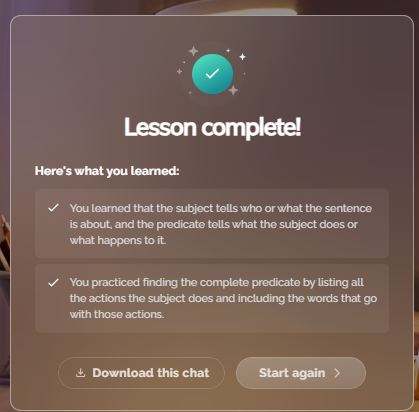
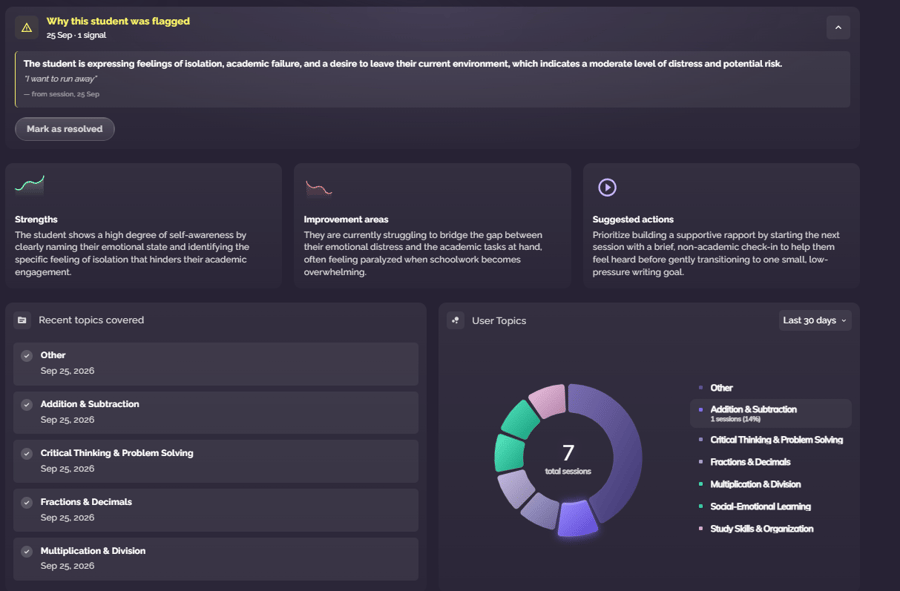
Khanmigo shows you the full chat history and emails you when a conversation is flagged. Lincoln AI Learning Coach allows the student to download the full chat. The parent dashboard gives you a list of topics your child has worked on in the past 7 or 30 days, as well as strengths, areas for improvement, and suggested actions you can take to support your child. It also alerts you if a conversation is concerning and shows you the portion of the conversation that prompted the alert. ChatGPT’s parental controls let you set quiet hours, study hours and content filters and it sends safety notifications, but it does not show you the conversations. OpenAI says trained reviewers look at a serious concern before a parent is notified, and that notifications can take a few hours to start after accounts are linked. Brainly parents with a linked account can track learning progress, see their child’s strengths and weaknesses, and help with homework once there is about a week of activity.
How do they compare on price?
Khanmigo is the least expensive paid option at $4 a month, and it covers up to ten children. ChatGPT and Brainly are free to start. Lincoln AI Learning Coach is $14.99 a month per child, or $149.99 a year, with a 7-day free trial. For that price, you get a coach that follows a K-12 curriculum, individual accounts for each child, a parent dashboard and safety alerts, and the safeguards we cover next. Whether that is worth $11 a month more than Khanmigo depends on what you want the tool to do. If your child already lives on Khan Academy, Khanmigo is a very good deal. If you want the coach tied to school curriculum and the parent dashboard, that is what the $14.99 buys.
For scale, private tutoring in the United States runs $25 to $80 an hour, according to tutorcruncher.com, so two one-hour sessions a week comes to roughly $215 to $695 a month. Any of the four AI options is a fraction of that. None of them replaces a good tutor for a child who is far behind. They are for the nightly homework that a tutor never sees.
Is it safe? What each one does to protect children.
Learning Coach keeps conversations on learning, redirects off-topic or inappropriate requests, and keeps its language age-appropriate. If a conversation raises self-harm or threats of violence, it alerts a parent by email and in the dashboard, or a teacher when a school provides it, and shows the part of the conversation that prompted the alert. Lincoln Learning Solutions is a member of the EdSAFE AI Industry Council. EdSAFE is the industry group that sets safety, accountability, fairness and efficacy expectations for AI in education. A membership is a starting point, not a guarantee. What matters is how the product behaves every day, which is why the guardrails and alerts matter.
Khanmigo uses moderation that emails a parent when a chat is flagged and stores chat logs for review. ChatGPT for Teens turns on under-18 protections by default and estimates a user’s age. In October 2026, Common Sense Media rated ChatGPT for Teens an unacceptable risk for users under 18. In its tests, newly linked parent accounts received no notifications during conversations of up to an hour about suicide, self-harm or disordered eating. OpenAI disputes the findings. Brainly has an honor code and moderators, and bans users who break it. Parents get progress updates but no safety alerts.
Student data is never sold, and student conversations and uploaded content are not used to train foundation models or improve the Learning Coach model.
Which one should you pick?
If your teen is 13 or older and free matters most, ChatGPT for Teens with Study Hours turned on is the option to look at. Know that a teen can switch the guardrails off, and read Common Sense Media’s October 2026 risk assessment before you decide. If your child already uses Khan Academy, Khanmigo at $4 a month is hard to beat. If you want quick answers to check finished work and you understand that answers are provided, Brainly is a solid choice. If you want a coach that follows a K-12 curriculum, cannot hand over the answer, and tells you what happened afterward, that is what we built Lincoln AI Learning Coach to do. It is $14.99 a month with a 7-day free trial, and you can cancel any time.
Try Lincoln AI Learning Coach free for 7 days
Questions parents ask
Does Lincoln AI Learning Coach ever just give the answer?
No. It asks what your child has tried and works through the problem one step at a time. If a child pastes in a problem and asks for the answer, Learning Coach turns it into a question back.
Can my child turn off the coaching or unlink from my account?
No. You set up and manage your child’s account from the parent dashboard, including their grade and birth month and year, and your child can’t switch off the coaching or unlink the account.
Is it only for older kids?
It is built for K-12, so it works for an elementary student as well as a high schooler, with language that is age-appropriate.
Can I try it before I pay?
Yes. The free trial is 7 days, and you can cancel any time.
Does it replace a tutor?
No. It is for nightly homework and studying. A child who is well behind still benefits from a person, and Learning Coach works fine alongside one.
Can my child use it with Khan Academy or other tools?
Yes. Nothing about Learning Coach requires you to stop using anything else.
How will I know if a conversation is concerning?
You get an email and an alert in the parent dashboard if a conversation raises self-harm or threats of violence, and the alert shows you the part of the conversation that prompted it.
Is ChatGPT for Teens safe for my child?
In October 2026, Common Sense Media rated ChatGPT for Teens an unacceptable risk for users under 18, after its tests found that parent notifications did not arrive during crisis conversations on newly linked accounts and that a teen can switch study mode off. OpenAI disputes the findings. ChatGPT is not available to children under 13.
What subjects does it cover?
Math, English language arts, science, social studies and electives, from kindergarten through 12th grade. Your child can ask any school question.
Is my child’s data sold or used to train AI?
No. Student data is never sold, and student conversations and uploaded content are not used to train foundation models or improve the Learning Coach model.
Sources
- Khanmigo for parents, khanmigo.ai/parents, checked September 18, 2026 (price, learners covered, subjects, parent tools).
- Khan Academy Help Center, “What safety features does Khanmigo have?” (chat history, moderation alerts).
- OpenAI, “Introducing ChatGPT for Teens”, August 18, 2026, and the OpenAI Help Center article “Managing parental controls in ChatGPT” (ages, Study Mode, what parents can and cannot see). Plan prices from openai.com, checked the same day.
- Common Sense Media, Youth AI Safety Institute, “ChatGPT for Teens Risk Assessment”, October 7, 2026 (rating, parent notifications, study mode, data use).
- Brainly, brainly.com, checked October 9, 2026 (prices, grades, parent view).
- Bastani, Bastani, Sungu, Ge, Kabakci and Mariman, “Generative AI Can Harm Learning”, University of Pennsylvania, 2024 (the 48%, 17% and hint-only results).
- TutorCruncher, US private tutoring rates, April 16, 2026 (the hourly rates in the price section).
- Lincoln AI Learning Coach for families, lincolnlearningsolutions.org/ai-families (our price, trial and features).